
Leading America’s Talent Revolution with theboardiQ - 2026
Updated: Mar 31

Could you please brief us about yourself and your motivation to embark in the HR Technology sector with theboardiQ?
My journey is defined by a relentless pursuit of excellence across the corporate and technology landscapes. I am a Strategic HR Technology Champion deeply rooted in experiential, immersive roles at Fortune 500 giants, including:
Motorola (Motorola Inc., Google, & Lenovo eras), where I served on India legal entity boards.
MetLife, Sun Microsystems, and IBM.
These experiences provided me with a front-row seat to the complexities of corporate governance and the critical importance of human capital. I have thrived by bridging worlds, operating at the forefront of Equal Opportunity, Tech Innovation, Domestic Resilience, and Sustainability.
The Motivation: Why theboardiQ?
theboardiQ is the direct result of observing a critical gap in how Corporate America's most influential seats are filled.
1. The Problem: The Gap in Executive Search
During my time in corporate leadership and while engaging in executive search in Silicon Valley, I realized that traditional methods of placing talent were often subjective and inefficient. There was a clear need to move beyond simple networking to a model based on precision and insight.
2. The Solution: Data-Driven Precision
My motivation is to ensure that the right skilled and knowledgeable executives are placed into positions of influence, specifically Board and C-Suite roles. I wanted to move beyond "gut feeling" and leverage technology to make these critical matches.
3. The Methodology: AI Meets Human Capital
I founded theboardiQ to blend my strategic HR expertise with cutting-edge technology. theboardiQ utilizes Generative AI, real-time analytics, and data-driven insights to create game-changing executive tools. By doing so, it is transforming executive search from a transactional process into a strategic science.
What inspired your transition from leading roles at global enterprises like Motorola (Google / Lenovo), MetLife, Sun Microsystems and IBM to building an equal-opportunity-driven HR tech platform like theboardiQ?
My transition wasn't just a career move; it was an integration of distinct, high-level experiences. Every workflow and feature within theboardiQ is a direct response to a gap or an opportunity I witnessed while leading at global giants.
At Motorola Google and Lenovo, navigating the 'East meets West' acquisition gave me the global perspective needed to build our proprietary leadership playbooks, Edge, ACE, and Compass.
At Google, I learned that true talent discovery must be blind to demographics but hyper-focused on values and skills probing behavioral situational based aspects - that is the engine behind our bias-free recommendation algorithms.
My time at Sun Microsystems and MetLife taught me the power of data visualization. theboardiQ dashboards stitched together disparate global data, from the World Bank to the UN, into one single source of truth.
Finally, my background in Executive Coaching drove the creation of our Edge Coaching Portal, which supported a multi-billion dollar conglomerate elevate it's North American Leadership Team's Global Impact.
How would you describe your leadership philosophy formed over three decades of steering transformation across technology and human capital functions?
The Core Philosophy: The Science of High Performance
True transformation occurs at the forefront of Technology, Data, and Human Potential. To build the boards and executive teams of the future, we must move beyond 'gut feeling' and embrace data-driven precision that reduces unconscious bias and accelerates speed-to-value.
The Four Pillars of Influence
The Scientist (Data & Precision): with theboardiQ - Treating Human Capital not as soft art, but as a measurable science. I apply the rigor of research and innovation to talent acquisition, ensuring that "fit" is quantifiable and reduces bias.
The Techie (Scale & Agility): Drawing from Big Tech giants (Motorola, Google, Lenovo, Sun, IBM), my approach emphasizes scalability and rapid iteration. I have the ability to understand that in an AI-driven world, the workforce must be as agile as the software they develop.
The Innovator (Structure & Resilience): Experience in Financial Services (MetLife, Phoenix) has instilled a philosophy of risk management and regulatory excellence. Innovation cannot happen without a robust compliance framework, especially in complex global markets.
The Communicator (Advisory & Governance): Through Strategic Consulting (theboardiQ, Positive Moves), I view the Human Capital function through the lens of the Boardroom, prioritizing governance, succession planning, and shareholder value.
Navigating the Modern Landscape
My leadership addresses the current volatility of the global market through three specific lenses:
Geopolitical & Supply Chain Agility: I view the workforce as a fluid, global asset. Navigating tariffs, supply chain shifts, and geo-political tensions requires a leader who can restructure teams across borders instantly, balancing hybrid and onsite needs without sacrificing culture.
The AI & Automation Paradigm: Rather than fearing redundancy, I embrace AI-led automations to elevate the workforce. My philosophy dictates that as low-level tasks are automated, the Human Capital function must rapidly re-skill talent for "future-focused" roles, ensuring the company stays ahead of the innovation curve.
Economic Efficiency: Building teams must be done faster, accurately, and economically. By reducing time-to-hire and increasing the accuracy of placements through targeted search and analytics, HR directly impacts the bottom line.
The Definition of the Modern CHRO
Based on my vision, the redefined role of the CHRO:
Traditional CHRO | The Business-First CHRO |
Focuses on policy and administration. | Focuses on Business Results, Product Innovation and P&L alignment. |
Reacts to headcount requests. | Data driven insights - predicts talent needs using real-time people analytics -rapid re-skilling, re-deployment for future focus areas |
Manages compliance as a checklist. | Leverages regulatory understanding as a competitive advantage. |
Accepts "culture fit" based on feeling. | Demands high-performing boards through intelligent and unbiased selection tools. |
Prioritizes retention generically. | Prioritizes and clearly differentiates competitive Pay-for-Performance philosophy to retain top talent. |
In what ways does theboardiQ’s zero-code platform redefine traditional models of board and executive recruitment toward achieving genuine equality and equity?
theboardiQ’s value proposition is aiming to disrupt traditional methods of Board and Executive Hiring in multiple ways.
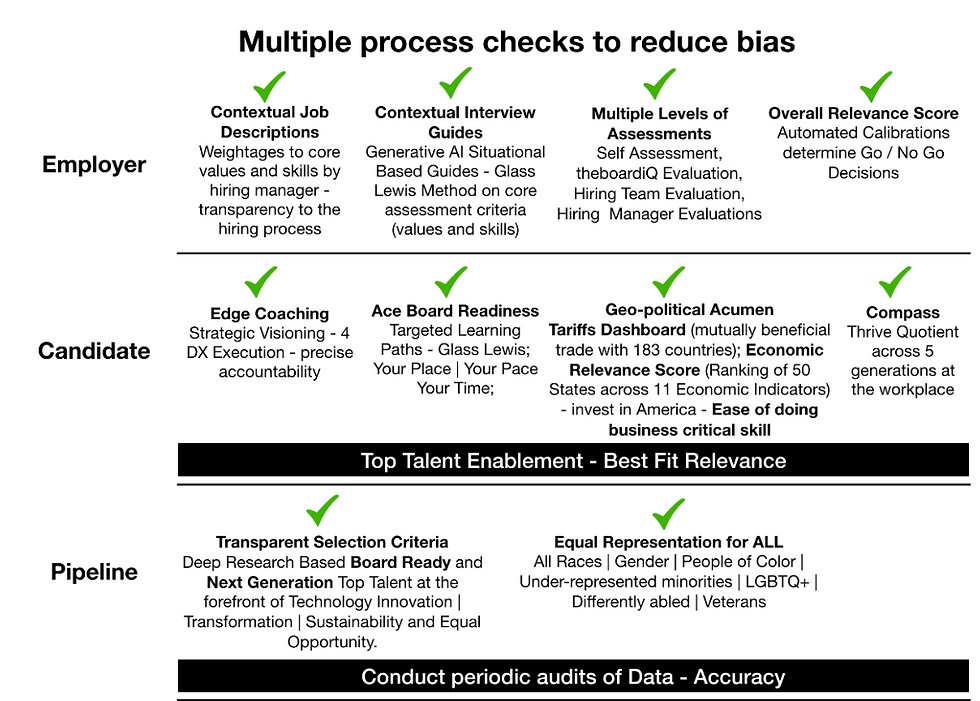
Can you share a specific example where you successfully used technology to eliminate systemic bias or create measurable inclusion outcomes?
A standout example of my work in this space is the 2024 and 2025 editions of theboardiQ Hall of Fame, where I utilized Generative AI (Gemini) to fundamentally disrupt the "closed-loop" nature of executive and board search.
Traditionally, identifying board talent relies on existing networks, which inherently scales systemic bias. By integrating Gemini into our zero-code platform, we shifted the paradigm from "who you know" to "what you have accomplished."
The Innovation: AI-Driven Contextual Scouring
The platform used Generative AI to move beyond static resumes. The AI scoured the expansive online presence—including white papers, speaking engagements, and patent filings—of thousands of potential leaders to build a cogent, comprehensive contextual profile based on the proprietary ACE Framework.
How it Eliminated Bias:
The "Blind" Filter: The AI was programmed to identify 100 individuals based purely on Values, Skills, and Knowledge. It ignored age, gender, and ethnicity during the initial identification phase, focusing instead on leaders at the forefront of Domestic Resilience, Technology Innovation, Transformation, and Sustainability.
Contextual Matching: For the first time, the platform used NLP (Natural Language Processing) to match a leader’s specific expertise (e.g., a "Scientist" profile) with the specific governance needs of a board (e.g., a "Technology Committee" chair), rather than just matching job titles.
The Results: Measurable Inclusion Outcomes
The outcome was not just a list of names, but a diverse, high-performing pipeline that Corporate America had previously overlooked:
Equal Opportunity Representation: 100 stellar individuals were identified from all walks of life—including veterans, LGBTQ+ leaders, and underrepresented minorities—purely because their ACE scores made them the most qualified candidates.
Board Readiness Levels: We categorized talent into three maturity stages:
Board Ready: Seasoned CXOs and CTOs prepared for immediate public company roles.
Subject Matter Experts: Academicians and inventors providing deep domain expertise.
Future Leaders: "Next-Gen" talent recommended for shadow boards and immersive experiences.
Efficiency & Accuracy: The platform delivered these recommendations faster and more accurately than a traditional human only research team, proving that technology can be the greatest equalizer in human capital.
The Philosophy in Action
This project proved that when you combine a Human Capital leader's insight with AI precision, you don't just "try" to be fair - you achieve equity through excellence. I replaced the "warm introduction" with an "objective recommendation," ensuring the best talent rose to the top regardless of their social circle.
Having served on multiple boards, how do you see boardroom dynamics evolving in response to demands for ESG-driven strategies and equitable governance?
Boardroom dynamics are at a critical inflection point in 2026. While the political climate remains polarized, the emergence of mandatory reporting—such as the EU’s Corporate Sustainability Reporting Directive (CSRD) and various global climate risk disclosures—has shifted the conversation from "voluntary values" to "fiduciary necessity".
I see this evolution unfolding across four key shifts in governance and accountability:
1. From "Soft" CSR to Hard Fiduciary Governance
The most significant change is the integration of ESG into core risk management and board oversight. Boards are increasingly adopting structured frameworks to move beyond rhetoric:
The WEF 4Ps Framework: More boards are utilizing the People, Planet, Prosperity, and Principles of Governance metrics to ensure a holistic view of value creation.
Materiality-Led Strategy: Rather than trying to "save the world" generally, high-performing boards are focusing on Double Materiality—understanding how sustainability issues impact the company’s bottom line and how the company impacts the world.
2. Tying Compensation to Concrete Metrics
Accountability is only real when it is reflected in the wallet. The trend for 2026 shows a massive surge in tying Executive and Board Compensation to ESG outcomes:
Variable Pay Alignment: Tying short-term and long-term incentives (STIs and LTIs) to hard metrics like carbon footprint reduction, supply chain ethics, and DEI milestones.
The Quantitative Shift: There is a strong push to move from qualitative "efforts-based" rewards to quantitative, audit-ready data to avoid "greenwashing" and satisfy institutional investors.
3. Consortiums and Unified Frameworks
A "consortium of leaders" is vital to ending the "patchwork" of global standards.
Harmonization: Organizations are moving toward the ISSB (International Sustainability Standards Board) standards to create a common language for investors.
Collective Action: Industry-specific consortiums are forming to solve supply chain challenges—such as human rights in manufacturing or decarbonization in heavy industry—that no single board can solve alone.
4. Radical Transparency at the Grassroots (PPPs)
The mission of theboardiQ—Égalité, Equal Opportunity, Equity—is being amplified through a new generation of Public-Private Partnerships (PPPs):
Hyper-Local Impact: Companies are partnering with state and local governments to drive impact at the grassroots, such as clean energy community projects or reskilling programs for displaced workers.
Accountability Dashboards: Boards are using real-time people and environmental analytics to provide transparent reporting to stakeholders, ensuring that equity is not just a goal, but a measurable result.
How do your proprietary frameworks, EDGE, ACE, and COMPASS, integrate into leadership development and strategic foresight for modern organizations?
theboardiQ proprietary framework, EDGE, ACE, and COMPASS, function as an integrated ecosystem designed to build high-performing boards and executive teams. While EDGE provides the strategic "umbrella" for growth, ACE and COMPASS serve as the specialized engines for individual readiness and cultural harmony.
Here is how they integrate to drive strategic foresight and development:
1. EDGE: The Strategic Execution Umbrella
EDGE (Executive Development for Governance Excellence) is the overarching coaching framework that ensures leadership development isn't just a "learning exercise," but a driver of Big Results.
Visioning (4DX Model): The platform integrates the 4 Disciplines of Execution (4DX) to move leaders away from the "whirlwind" of daily tasks. By focusing on Wildly Important Goals (WIGs), the platform ensures that leadership development is directly tied to strategic breakthroughs.
Accountability & Rewards: The framework uses a centralized dashboard to track a winning mindset. I believe Rewards = Results, so I aim to align compensation and variable rewards with the achievement of these goals, ensuring skin in the game.
2. COMPASS: The Generational Wisdom Engine
In an era of five generations in the workforce, COMPASS is my indigenously developed "Thrive Quotient." It redefines culture from a static set of values to a dynamic, generational strength-builder.
Bridging the Gap: COMPASS identifies the unique wisdom of Baby Boomers and Gen X (institutional memory/governance) and integrates it with the digital fluency and sustainability focus of Millennials and Gen Z.
The Thrive Quotient: This metric assesses how well an organization leverages its multi-generational talent. It ensures that "subject matter experts" (the older generation) and "innovators" (the younger generation) are collaborating rather than clashing and competing.
3. ACE: Contextual Board & Executive Readiness
ACE is the engine for Executive Enablement. It moves beyond generic training to create a customized "Board Readiness Path" that is faster, more accurate, and more economical.
The Framework: ACE focuses on Values, Skills, and Knowledge to match leaders to their specific "best-fit" board roles (e.g., Audit vs. Tech Committee).
GenAI-Powered Learning: Using Generative AI, the platform curates content from MOOCs, governments, and SMEs. It allows candidates to learn at their place, their pace, and their time, culminating in a certification that proves they are "ready-now."
Accessibility: By making 90% of the courses free, we democratize the path to the boardroom, specifically targeting underrepresented talent to achieve Égalité and Equity.
Integration Model: How they work together
Framework | Primary Function | Business Impact |
EDGE | Strategic Oversight | Ensures execution of "Wildly Important" business goals. |
COMPASS | Cultural Integrity | Leverages 5 generations of wisdom to thrive |
ACE | Talent Pipeline | Reduces unconscious bias and identifies "Board-Ready" talent. |
Could you share insights into how HR technology is transforming executive decision-making and talent management lifecycles in today’s business context?
In 2026, the shift from Generative AI (which creates content) to Agentic AI (which takes autonomous action) has fundamentally rewired the HR value chain. At theboardiQ, I view this not just as a technological upgrade, but as a "Superagency" era where human judgment is amplified by machine precision to make executive decisions more defensible and equitable.
The transformation of executive decision-making and talent management is occurring across four critical dimensions:
1. From "Gut Feeling" to Defensible Talent Discovery
Traditional recruitment often suffers from the "Affinity Gap", the unconscious tendency to hire for "culture fit" rather than "competence fit."
NLP-Driven Contextual Analysis: The platform uses Natural Language Processing to deconstruct unstructured executive data. Instead of scanning for names or prestige markers, the AI identifies transferable skills and adjacent qualifications. This allows the platform to discover "Ready-Now" talent from non-traditional backgrounds who are technically superior but often invisible to human-led searches.
Algorithmic Fairness: By ranking candidates on an objective ACE Score (Values, Skills, and Knowledge), the platform ensures that the shortlist is based on data-driven merit. This moves the board's role from "Who do we know?" to "Who is the most qualified leader for our 2026 growth strategy?"
2. The Rise of "Agentic" Global Dashboards
Executives are no longer satisfied with static quarterly reports. They require real-time, prescriptive business intelligence to navigate a volatile global economy.
The Tariffs Dashboard: Utilizing Agentic AI to scour over 185 nations' trade data, we provide boards with an immediate understanding of how geopolitical shifts impact their talent and manufacturing costs.
Economic Relevance Score: This proprietary metric transforms regional economic vitality data into a strategic indicator. Boards use this to decide where to build new innovation hubs based on government efficiency and the availability of future-focused skillsets.
3. Hyper-Personalized Board Readiness (ACE)
In 2026, the talent lifecycle doesn't end at "hiring", it evolves through continuous enablement.
ACE Learning Paths: The platform's AI creates personalized, self-paced "Board Readiness" paths. By identifying an individual’s specific gaps (e.g., ESG governance or Cybersecurity oversight), the AI curates custom content from MOOCs and subject matter experts.
Your Pace, Your Time: This democratization of knowledge ensures that "Future Leaders" are being groomed within the flow of work, reducing the high cost of external executive search in the long run.
4. Human-AI Collaboration: The Ethical Guardrail
While AI drives speed, Human Oversight provides wisdom. Our philosophy at theboardiQ is to use AI as a tireless analyst while maintaining human judgment as the final arbiter.
Auditable: theboardiQ maintains a "Humans-in-the-Loop" model to ensure that AI recommendations are audited for accuracy and free from "hallucinations."
Regulatory Compliance: With the EU AI Act and other global regulations in full force by 2026, our technology is designed to meet stringent transparency requirements, ensuring that every executive placement is legally and ethically sound.
Executive Summary: The 2026 Decision Model
Feature | Traditional Model | theboardiQ (AI-Infused) |
Search Scope | Rolodex-based (Limited) | Global Data Scouring (Infinite) |
Evaluation | Subjective Interviewing | Objective ACE Scoring (NLP/ML) |
Strategy | Descriptive (What happened?) | Prescriptive (What should we do?) |
Equal Opportunity Approach | "Check-the-box" Quotas | Bias-Free Talent Discovery |
Never before has it been easier to harness the power of AI on a real-time basis to create meaningful and high impact dashboards that enable quick decision making for boards and executive teams. The ability to understand topical matters of strategic importance, drives the overall blueprint in shaping some of these tools.
As a strategist blending sustainability with digital transformation, how do you balance growth imperatives with ethical and environmental accountability?
In the rapidly shifting 2026 landscape, the role of a strategist is to move beyond the false dichotomy of "profit vs. purpose." Balancing growth with ethical accountability requires a layered temporal strategy where digital transformation acts as the primary vehicle for sustainable impact.
My approach to this balance is structured across three horizons of growth and a modular "Build, Buy, Partner" technology stack.
1. The Growth Horizons: Temporal Accountability
Driving growth in a volatile geopolitical climate requires different levers depending on the timeline.
Short-Term: The Governance Guardrail Growth must stay within the "rails" of legal and ethical frameworks. The focus here is on Protecting Reputation through radical transparency. We measure and execute core metrics, like carbon footprint per transaction or diversity in top-tier leadership, to ensure the business remains "compliant but competitive."
Medium-Term: The Grassroots Multiplier. Here, we transition from individual corporate goals to Public-Private Partnerships (PPPs). By aligning with common agendas like financial inclusion, we use the company's scale to touch the grassroots. This creates a "double-benefit" model where community prosperity fuels the company's future customer base.
Long-Term: The Legacy of Social Impact. The ultimate imperative is Elevated Public Recognition through tangible social change. Long-term growth is secured when the brand becomes synonymous with systemic solutions, such as achieving net-zero supply chains or pioneer status in ethical AI, thereby "future-proofing" the enterprise against regulatory or social shifts.
2. The Digital Strategy: Build, Buy, Partner
The "Digital Stack" is the engine that makes this accountability possible. The decision on how to source technology is a strategic one, based on the Value Proposition:
Strategy | When to use it | Strategic Outcome |
Build | For core, proprietary sustainability algorithms or unique human capital data. | Internal Capability: Full control over the ethical and data privacy standards of the transformation. |
Buy | For standard components like ESG reporting software or cloud-based HRIS. | Speed & Economy: Leveraging off-the-shelf "best practices" to quickly meet regulatory disclosure requirements. |
Partner | For complex transformations like AI-led automation or deep-tier supply chain audits. | Expert Agility: Forging alliances with Subject Matter Experts to stay ahead of the technology curve without the overhead. |
3. Sustainability + Digital: The Intersection
By blending these two, the strategist creates a Circular Transformation Model. Digital tools (like digital twins or real-time people analytics) are used to monitor and reduce environmental impact, while sustainability targets (like the WEF 4Ps) provide the "Why" behind the digital investment.
This ensures that the transformation is not just a technology upgrade, but a business model evolution that turns ethical accountability into a competitive moat.
Reflecting on your M&A experience, how do you ensure that the human capital dimension remains central during major organizational shifts?
Getting your top talent to be at the forefront of organizational shifts is key. They become enablers and drive behavior to accept complex and at times ambiguous strategy. In all of the major M&As and Divestitures, HR played a facilitating role in the overall strategy and execution with very strict milestones, shared goals, transparency in communication and tangible outcomes.
The CHRO’s M&A Scorecard
Success Factor | Metric for Success | Strategic Outcome |
Talent Retention | Retention rate of "Key Personnel" (Tier 1) | Protection of core IP and leadership stability. |
Cultural Alignment | Employee Sentiment Index (Post-Merger) | Reduced friction and faster "Speed to Value." |
Operational Continuity | Zero downtime in core HR services | Maintaining business-as-usual productivity. |
Execution Speed | Time to achieve "Single Entity" status | Accelerated realization of financial synergies. |
The above viewpoints are responses to a recent interview done by Smitashree Menon, Founder and CEO, theboardiQ LLC and represent her personal views, as she continues to embark on her growth journey with theboardiQ LLC.


Comments